
What if AI Eats Software and Then Stops
Finding New Jobs for Old Programmers

I’ve been damn impressed by how good AI has become at writing software. From its humble beginnings of scraping leetcode forums, now it can surprisingly often one shot any prompt for code, as well as help you debug and run it.
In business, the share of expenses going towards software has risen nonstop:
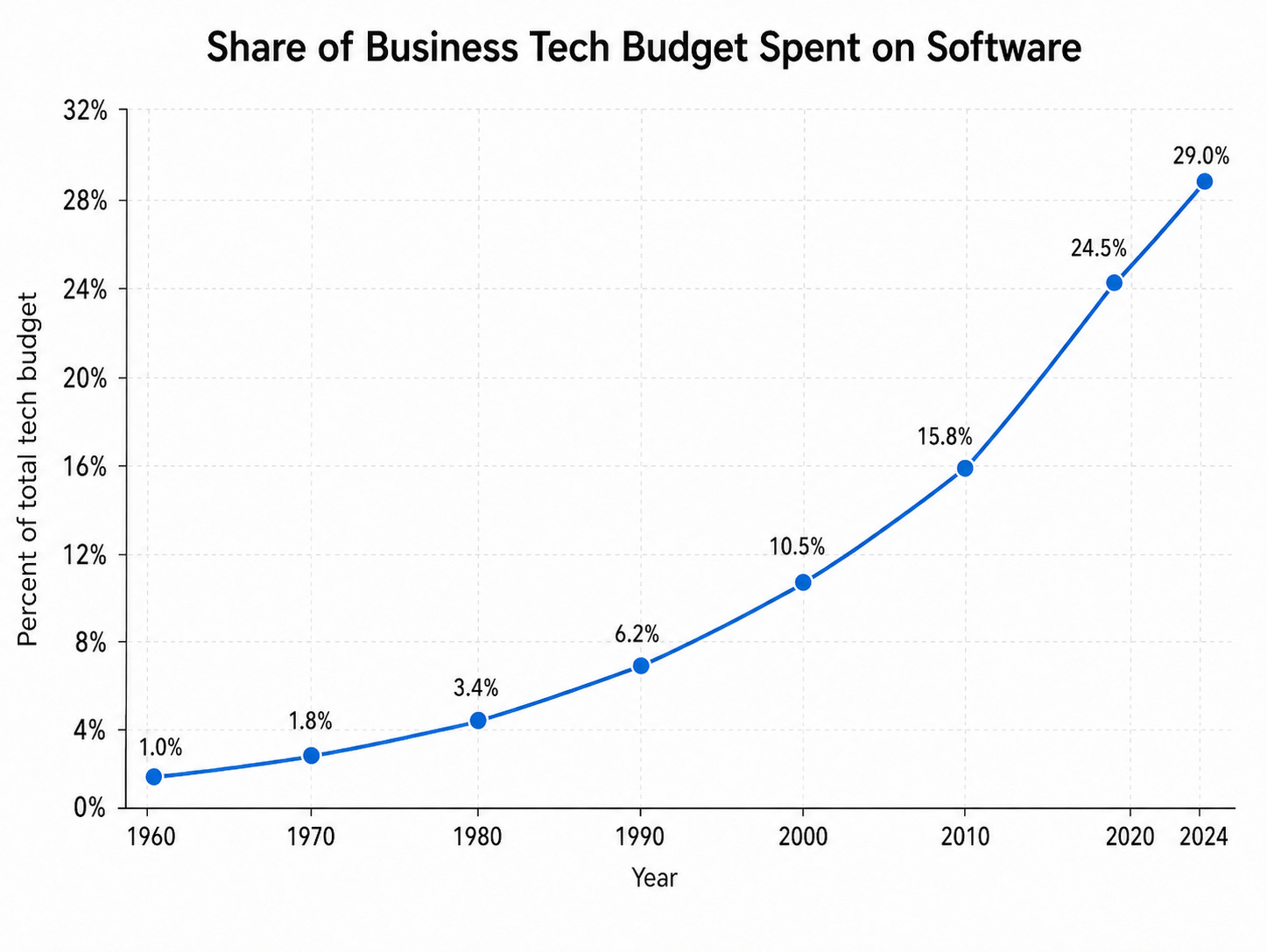
As well as academia (which has to pay for IT and software but rarely benefits from it) , and the military, which $16 billion just for software upgrades to the F35 recently.
This has become normalized; we all expect that software will become a bigger and bigger part of the economy over time, in both profits and expenses.
But what if it isn’t? What if there was a machine that did to programmers what the chainsaw did to lumberjacks, and we simply don’t need them anymore? What if vibe coding becomes so strong that product managers can speak their ideas into existance? Meanwhile, the legacy code developed over decades by armies of skilled open source dev continues to chug away—it doesn’t need to be continously developed. It has already been developed.
Some people are afraid that AI will become so good that it can do anything, leaving humans in either dystopia or utopia depending on your point of view. Not me. My belief is that AI will hit another S-curve. It will not learn to do everything. It still struggles to do most of the mundane tasks of the physical world, such as driving cars, cooking food, or building physical things. And its view of humans is still rather artificial.
For the sake of argument, let’s assume I’m right about the limits of AI. Where does that leave us? We’ll have a lot of smart, hardworking, talented people with unprecedented access to information, but no job.
This situation will not last long; nature abhors a vacuum. These people are going to find job—but where?
I believe the answers will be found in the sectors that have, until recently, suffering from Baumol’s Cost Disease. Notably: construction, education, and health care.
If Houses Are Too Expensive, Just Build Your Own?
We do have, as many have noted, a housing crunch. There’s just not enough houses to go around especially in big cities. More available if you move to small towns or suburbs but the houses there tend to be of less than desirable quality. But building a house is not an impossible task! Commercial construction is made unpleasant by the race to build as fast as possible, and DIY contruction is limited by any one person’s lack of knowledge. But AI can provide that knowledge, and there’s no reason to make it an unpleasant race when you’re building your own dream home. It could be made soothing, satisfying even, to do real work in the real world with your own hands while AI handles the technical details.
The Smallest Class Size Is One
It has been argued that aristocratic children in the past benefited greatly from one-on-one instruction. This is obviously not possible for everyone in modern society, so we cram them all together and force one poor overworked teacher to teach them all together at the same time. This system is rather less than optimal for education, although I suppose it does prepare them for a lifetime of working in shifts at the factory. Too bad those jobs are also gone.
Perhaps you’re thinking “we won’t need teachers anymore; the kids can learn everything from AI.” I strongly disagree with that view. First of all—have you met kids? They’re easily distracted! They’re not going to just sit down diligently studying with a computer, they’re going to get distracted and mess around without a human teacher to guide them. Even adults need that guiding hand sometimes.
But it’s not just discipline. There is something about human psychology that innately resists learning from a machine—having another human face motivates us, and provides unique insight that a machine simply can’t match. I expect that more people than ever will find work as coaches, instructors, and educators of all sorts in the coming years, focusing heavily on 1:1 instruction. Oxford, at least, still believes in this style of teaching, and there is an organization called “Quintessential Governess” which wants to expand it.
Make More Doctors
(And not just doctors but also nurses, PAs, medical billing associates, and everything else in the medical industry. But mostly, the sort of doctor who can treat you individually, instead of as a cog in the machinery of the vast medical complex.)
Part of the reason the number of doctors is so lacking is that the number of doctors is lacking. This might sound like just a tautology, but it’s more than that—the current system is that they train in residence with working doctors like a medieval apprenticeship, so there’s very limited ability to grow the overall population of doctors. The same is true (to some extent) for most other medical jobs.
You obviously can’t perform surgery on yourself, or let AI do it. But you can use AI to train new residents, and thus increase the number of doctors overall, as well as making them more efficient. Let doctors make housecalls again, and focus on prevention, which then frees up hospitals for the true emergency.
That’s my vision, anyway. I’d love to get feedback on this from anyone who actually works in these fields, to see if they think this is at all feasible.