
Should I do a Startup
Probably Not But What the Hell Else Am I Supposed To Do

I read a joke somewhere that goes like this:
In New York, everyone asks “what do you do?” In LA, they ask “who do you know?” In San Francisco, they ask “what’s your startup?”
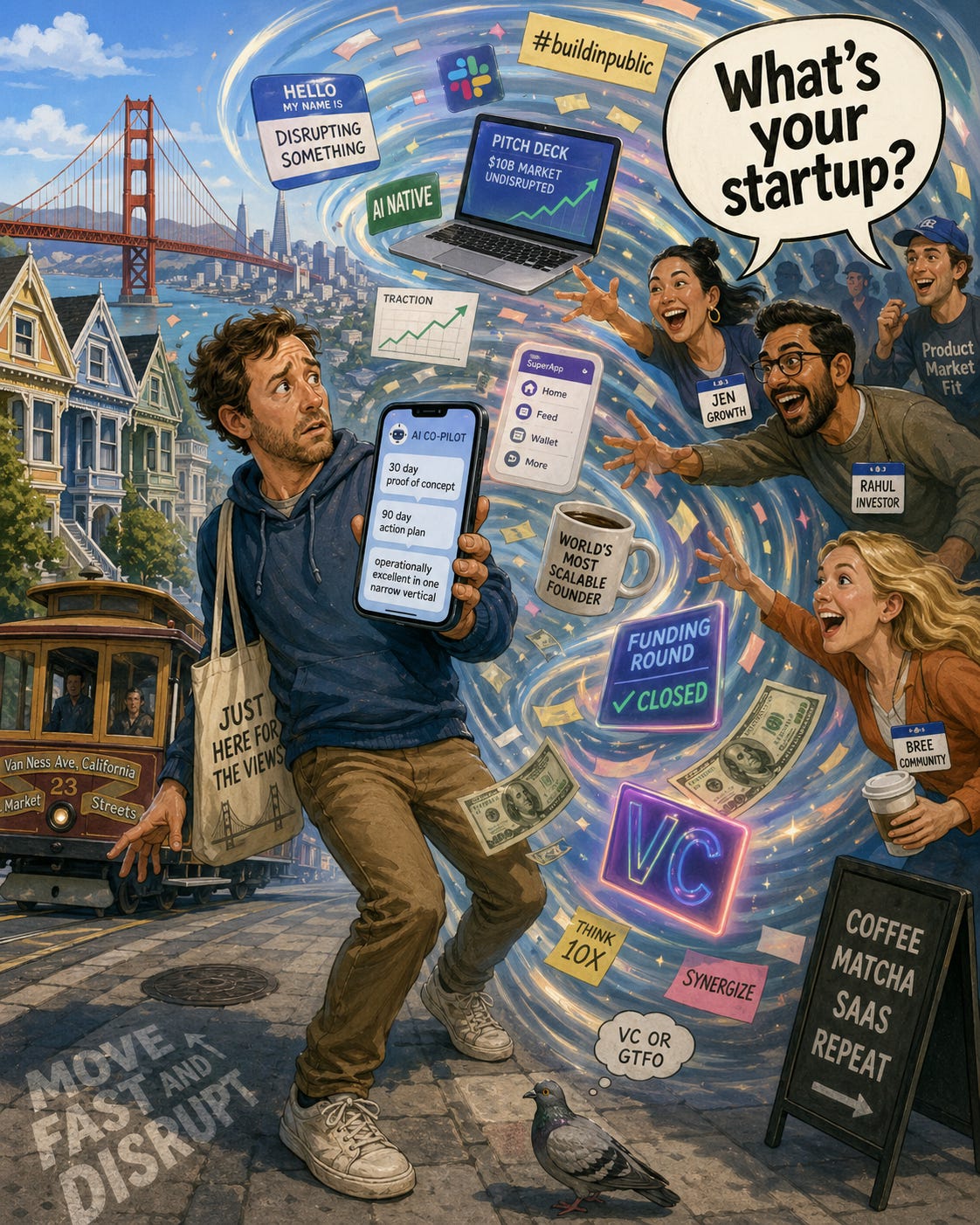
It’s not literally true of course, but it does feel that way. There’s just so much of a buzz around tech startups in San Francisco that it dominates everything, and seeps into conversations even when it’s not wanted. People will quit well-paying normal jobs to pursue a startup that has no realistic chance of succeeding. Other cities have startup scenes too of course, but not nearly to the same extent: SF has as much startup capital as the next ten cities combined. And SF really isn’t all that big of a city either, just 800,000 people live in its city proper, so all of this crazy tech energy gets concentrated.

Which is all to say that, as a visitor to San Francisco (and the surrounding Bay Area), I find myself getting sucked up into this atmosphere of tech and startups much more than I would have expected. Doing a startup was not something that ever appealed to me at all, but now it seems quite exciting. I’m breathing the air and drinking the Koolaid.
But Who Are You, Anyway?
I’m just some guy. I don’t have a PhD, and I can’t claim to be the world expert on anything. I did work as a programmer for 10 years, but that was a while ago and it seems increasingly irrelevant as the tech scene changes. I’ve had various life experiences, some of which I’ve written blog posts about, but none of them seem directly relevant to the startup world.
But maybe that’s OK. So many startups deal with technology that’s either brand new or underexplored that there might not be a world expert on it. And it’s increasingly possible to reach high technical knowledge of a field quickly if you really push yourself on it, thanks to a mix of AI, open textbooks, and networking with other experts. I met someone yesterday who appeared quite knowledgeable about AI and I assumed he had a long career in it, until he told me that he had only started seriously researching it last November.
I do have certain other attributes that seem well-suited to the startup world. I have a reasonable amount of funds and no full time job, so I can fully focus on this. I’ve spent an enormous amount of time reading grandiose ideas in blogs, web forums, and science fiction. I’m fairly good at talking to both technical and non-technical people. I’ve finally reached a point where I have the maturity to grind through boring obstacles but also immature enough to launch a crazy business venture. And perhaps most important: I’ve got the desperation that can only come from realizing that I’ve got a huge gap in my resume and no normal person would ever hire me right now, so there’s no choice but to do it myself.
So What’s Your Startup Idea?
I don’t have one. That’s the biggest problem for this plan.
OK, I do have various crazy ideas for startups. But they’re all far too vague and ambitious to be viable as a startup. Also, most of them don’t really involve software, which is what startups tend to do best.1
I spent several hours yesterday going through various ideas with ChatGPT. It told me, in the most polite way possible, that my ideas had more holes than a bowl of Cheerios (not the fun Alphabits that could be the next Alphabet).
It was, however, very helpful in helping me develop them into something more practical. It was full of impressive phrases like “30 day proof of concept,” “90 day action plan,” and “the way to win is to be operationally excellent in one narrow vertical before expanding.” It turned my crazy asteroid gold idea into “A Bloomberg/Edgar/Crunchbase-style intelligence platform for space resources and asteroid mining.” It gave me some specific advice that was tough, yet actionable, making me feel like I really could do this, or least do enough to get my foot in the door.
But of course it’s still just an AI, so whenever I pushed back on anything it did the typical AI where it instantly folds and agrees with me. It’s just aggregating all of the most statistically relevant business/startup advice, it’s not actually thinking through the details. And now everyone else is using AI, especially all the tech/startup bros, so there’s a Goodhart problem where, even if this advice would have been good in the past, it’s now so common as to be useless.
We must all remember to be in the machine but not of the machine—conscious of its limitations as well as its strengths.
Many exceptions of course, most famously Tesla. But there’s a good reason that so many startups default to some sort of B2B SAAS: it works.
> I did work as a programmer for 10 years, but that was a while ago and it seems increasingly irrelevant as the tech scene changes
I actually think this has never been more relevant. The gap between 'vibe coding' and 'vibe engineering' is still very much a thing. There's never been a better time to build!